AI becomes more useful when it can work with relevant information and approved tools. Model Context Protocol, usually shortened to MCP, provides a common way to make those capabilities available. Understanding its role helps you ask better questions about an integration project.
What MCP does
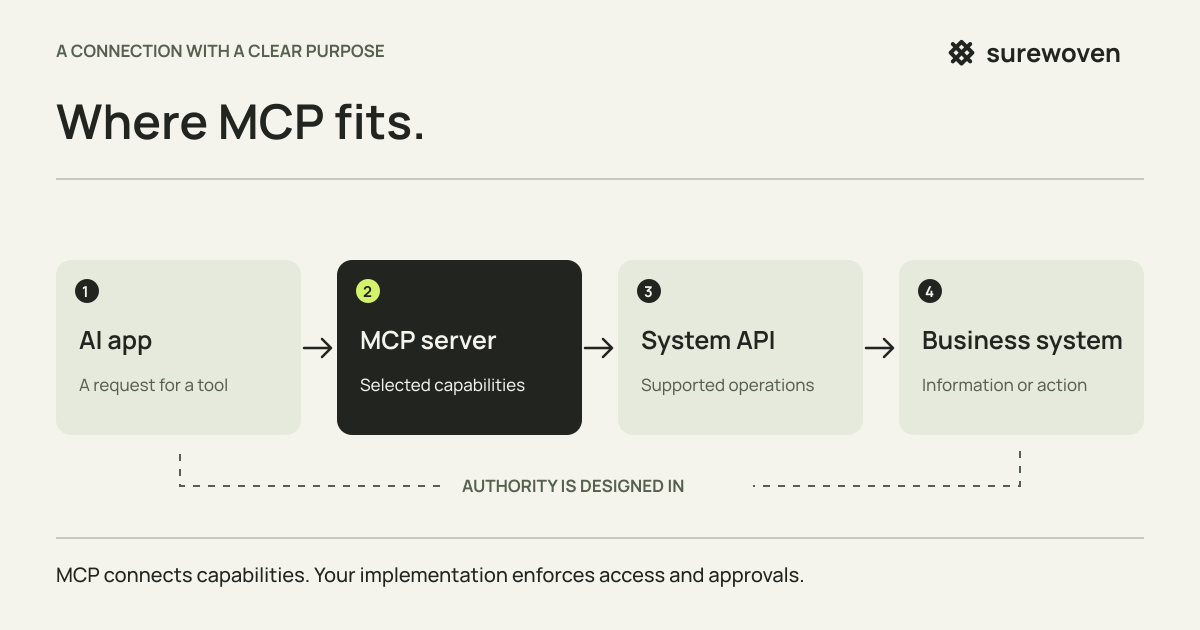
MCP is a protocol for communication between an AI application and connected services. A server can expose tools that perform operations, resources that provide context, and prompts that support an interaction. Compatible applications can discover and use the capabilities the server offers.
For a business, the useful idea is a defined connection between an AI experience and the capabilities it needs. The protocol describes how they communicate. Your implementation determines which systems are connected and how the resulting experience behaves.
How it relates to an API
An API gives software a way to interact with another system. An MCP server can use an existing API behind the scenes and present selected capabilities in a form an AI application understands. It does not remove the need for a supported interface to the underlying system.
A direct API integration may be appropriate for a fixed workflow. MCP may be useful when capabilities need to be discovered and used by compatible AI applications. Existing integration platforms may already solve part of the problem. The decision starts with the intended use and operating requirements.
Why reusable connections matter
When several workflows need the same capability, a shared connection can provide a consistent place to maintain that capability. Changes can be assessed against the applications that depend on it, rather than being repeated independently in every workflow.
Reuse still requires ownership. Someone must maintain the connection, document its behaviour and manage changes. Compatibility also needs to be tested: supporting MCP does not guarantee that every application supports the same features or authentication arrangements.
Decide what the connection may do
A connection needs an identity and appropriate access to its underlying systems. Define what the caller can read, which actions are available and when a person must approve a proposed change. Enforce those decisions in the application and connected services.
Tool descriptions help an AI application understand a capability, but descriptions and advisory labels are not access controls. The business should be able to explain how unauthorised actions are blocked and how approval relates to the exact action being carried out.
Make outcomes understandable
A workflow needs to know whether an operation succeeded, returned no suitable information or failed to run. Those outcomes should remain distinguishable as information passes through the connection. Otherwise a temporary system problem can be mistaken for an ordinary business result.
Agree how timeouts, failed calls and repeated requests are handled. Consider what a person will see if the connection becomes unavailable, which information is retained for investigation and how sensitive content is kept out of unnecessary logs.
Check the practical fit
Before commissioning an MCP integration, establish who will use it and where it will run. Review the systems involved, their supported interfaces and licensing arrangements. Confirm the authentication approach, hosting requirements and responsibility for ongoing changes.
Australian organisations may have specific requirements for data handling, supplier arrangements or processing location. These need to be checked against the actual services selected. Adopting a protocol alone does not establish where data stays or which organisational obligations are met.
Questions for your integration partner
A useful proposal should make the following clear:
- Why is MCP suitable for this connection?
- Which capabilities will be exposed, and to which users or applications?
- Where are permissions and approval decisions enforced?
- How will failures, usage and changes be observed?
- Who will maintain the connection and test compatibility over time?
Further reading
Primary references for the technical concepts in this guide.
This guide shares a practical approach to evaluating AI. Any examples are illustrative; the right design and results depend on your business, systems and scope.