A business task rarely ends with an answer. Information needs to reach the right place, a decision may need review, and someone needs to know whether the work finished. A connected AI workflow is designed around that whole journey.
Describe the finished work
Start by describing what a person should be able to rely on at the end. A suggested action, an approved action and a completed action are different results. Decide which one the workflow is responsible for producing and who is responsible for the next step.
Then work backwards. Identify the information needed, the system that owns it and any decision that requires judgement. This gives the project a clear boundary before a model or framework is selected.
Separate interpretation from execution
AI can be useful when a task involves varied language or information that is difficult to express as a simple rule. Conventional software remains useful for checking required fields, applying fixed conditions and moving data between systems.
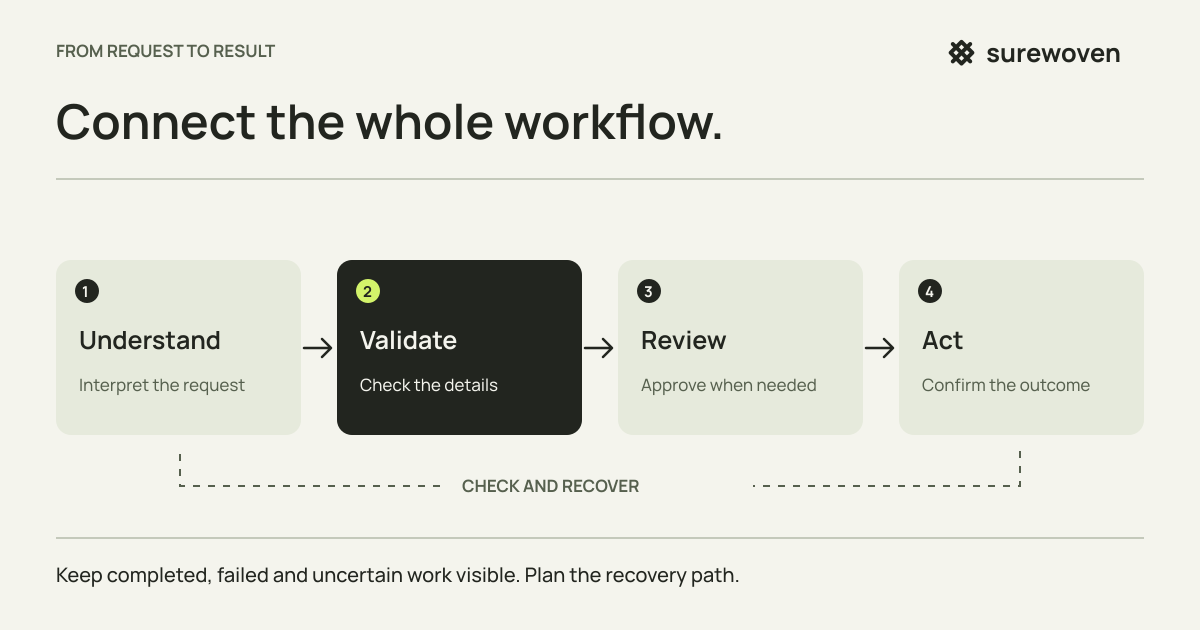
These capabilities can sit in the same workflow. A flexible interpretation step can produce a proposed result, followed by validation and an authorised action. Each step should have a clear input, a defined outcome and a response for information it cannot handle.
Give each part a purpose
Some workflows benefit from focused AI capabilities with separate responsibilities. Others work well with a single agent or a fixed sequence. A larger collection of agents introduces coordination, more interactions and additional behaviour to test.
Ask what each part contributes. Can its result be checked? Does it need its own tools or permissions? Can another part use the same capability without inheriting unrelated business decisions? Split responsibilities where that makes the system easier to understand and operate.
Connect tools with defined authority
An AI application needs a controlled way to reach information and perform permitted actions. Supported APIs, integration platforms and standards such as MCP can provide that connection. The surrounding design determines what a particular user or workflow is allowed to do.
Keep business decisions explicit. The ability to retrieve information should not silently become permission to change it. Approval should be attached to a specific proposed action, with enough context for the reviewer to make a meaningful decision.
Design the interrupted journey
A connected workflow depends on systems that may be slow, unavailable or inconsistent. It needs to distinguish between a task that found no matching information and a task that could not perform the search. Those outcomes require different responses.
Consider what happens if work stops after a change has already been made. Before repeating an action, the workflow may need to check the current state. A useful recovery path tells a person what completed, what remains uncertain and what they can do next.
Make expansion a deliberate decision
A focused workflow can reveal reusable connections and useful knowledge foundations. Expansion should follow evidence about quality, effort and operating cost, together with feedback from the people using it. Adding another capability is worthwhile when it improves a defined part of the work.
For an Australian business, discovery should include the operating details that affect the journey: local language, date formats, time zones, trading hours and the availability of reviewers. These belong in the design wherever they influence a decision or handoff.
Questions to settle before building
Use these questions to turn an attractive idea into a practical brief:
- What result will count as completed work?
- Which information and actions are required, and who may access them?
- Which decisions follow rules, need AI interpretation or require a person?
- What happens when a step fails or its result is uncertain?
- Who owns the workflow, and what evidence will justify expanding it?
Further reading
Primary references for the technical concepts in this guide.
This guide shares a practical approach to evaluating AI. Any examples are illustrative; the right design and results depend on your business, systems and scope.