A pilot helps you learn whether an idea is useful. Everyday operation asks more of it: varied requests, changing information, unavailable systems and people who need to trust the next step. Moving forward means making those conditions part of the design.
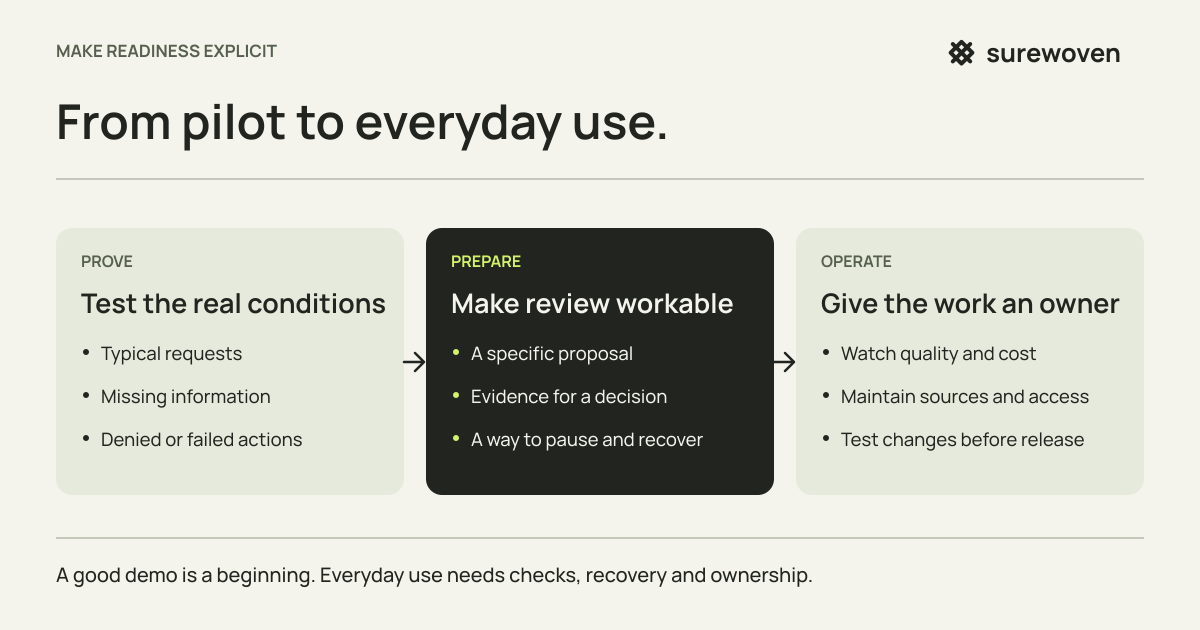
Agree what ready means
Define the scope of the first live release and the evidence needed to support it. Consider output quality, appropriate access, review effort and the consequences of an incorrect action. Give each requirement an owner who can assess whether it has been met.
A launch decision should also record known limitations. People need to understand which requests the system can handle, which it should refer elsewhere and how to recognise an outcome that needs attention.
Test more than successful requests
Build a test set that reflects the range of work the system will encounter. Include incomplete information, ambiguous requests, unavailable sources, denied access and interruptions during a task. Agree the expected behaviour before reviewing the results.
A fluent answer can still be unsupported or unhelpful. Review whether the result is grounded in suitable evidence, follows the agreed boundaries and gives the person a useful next step. Keep a record of recurring failures so improvements can be checked against the same scenarios.
Make human review workable
Approval adds value when the reviewer understands what they are being asked to decide. Show the proposed action, relevant evidence and any uncertainty. Give them a practical way to correct or decline it.
Decide what happens while approval is pending and when the reviewer is unavailable. If the underlying information changes before execution, the proposal may need to be checked again. Design review around real staffing and operating hours so the workflow has a workable path forward.
Plan for failure and recovery
A system may stop after completing part of a task. The team needs to distinguish completed work from work that has not started and work whose outcome is uncertain. This becomes especially important when repeating an operation could produce a duplicate change.
Document how the workflow can be paused, investigated and resumed, or handled manually. Agree which failures can be retried automatically and which need a person. Try the recovery path before relying on it during a live interruption.
Understand the cost of everyday use
Operating cost includes more than model usage. Consider connected services, processing, storage, monitoring, review time and maintenance. The useful comparison is the overall effort and cost of completing the work to the required standard.
Make usage visible and set appropriate limits on repeated attempts, execution time and access to costly operations. Review how the system behaves when a limit is reached. The person using it should receive a clear outcome rather than wait indefinitely for work that cannot finish.
Give the system an owner
Choose who maintains source information, reviews feedback, manages access and responds to failures. Define how software or model changes are evaluated before they affect live work. Documentation should help the responsible team operate the solution without relying on the memory of its original builder.
An initial rollout can be limited to an agreed group or task. Use what happens in practice to decide whether to expand, improve the design or return to the previous process. Ongoing support arrangements should be explicit in the project scope.
A practical launch conversation
Before everyday use, make sure the team can answer these questions:
- What is the system allowed to do, and how is that boundary enforced?
- Which test results support the launch decision?
- Who reviews important actions and handles exceptions?
- How do we stop, investigate and recover incomplete work?
- What will we monitor, and who decides when a change is needed?
This guide shares a practical approach to evaluating AI. Any examples are illustrative; the right design and results depend on your business, systems and scope.