These labels often overlap. A more useful way to choose is to ask what the system needs to know, what it needs to do and what should remain a human decision.
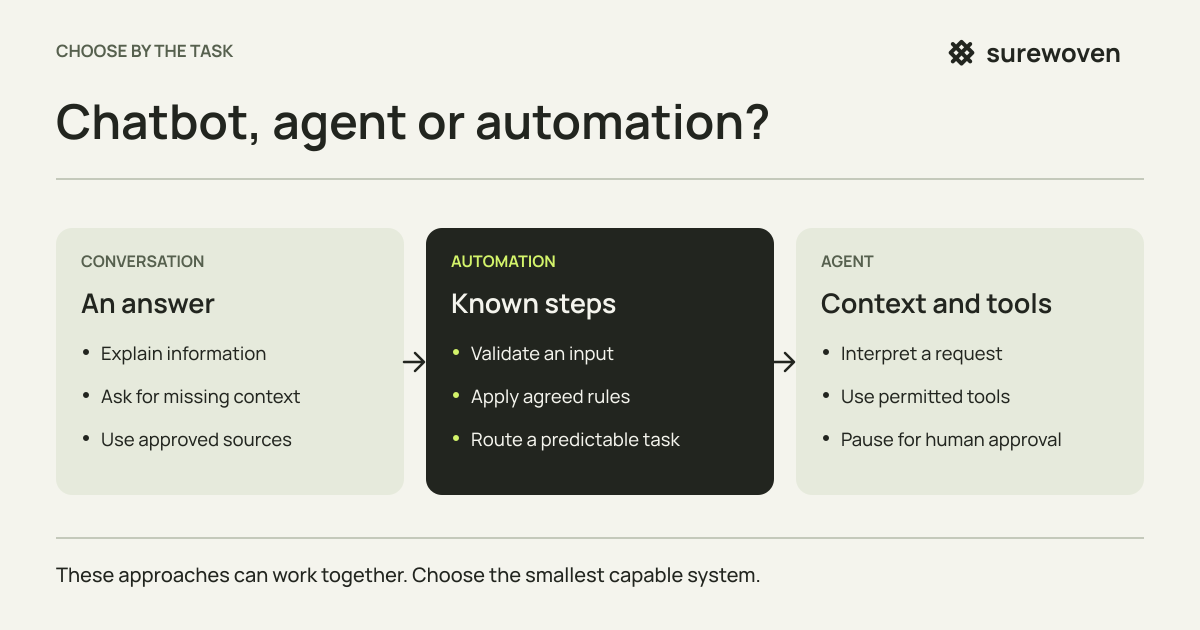
When the task is answering a question
A conversational assistant may be enough when someone needs an explanation or an answer from approved information. The important controls are the quality of that information, the ability to cite it and a sensible response when the answer is missing.
When the task follows known rules
Use ordinary automation when inputs and decisions are predictable. For example, a validated form can create a record and route it to a team without an AI model deciding where each field goes. Simpler systems are often easier to test and operate.
When the task needs context and tools
An agent can help when completing a request requires interpreting an instruction, finding relevant information and selecting from approved tools. An order-status lookup is different from changing an order: the second task needs tighter permissions and may require approval.
Draw the permission boundary first
Write down which tools the system can use, which records it can access and which actions need a person. A helpful draft and an authorised action are different outcomes. Test both the allowed cases and requests the system must decline.
Choose the smallest capable system
You can combine these approaches. A conversation can collect context, a rule-based workflow can validate it, and a person can approve an action. Start with the simplest design that solves the actual problem and makes its behaviour understandable.
Compare the job before choosing the label
Use this comparison to describe the capability you need. A project can combine several rows. A chat interface alone does not tell you whether the software can access tools or change records.
| The work needs | A useful starting point | Check before building |
|---|---|---|
| An answer from approved information | A conversational assistant with retrieval. | Source quality, access, references and unanswered questions. |
| The same steps for predictable inputs | A conventional automated workflow. | Validation, repeated events and exception handling. |
| Interpretation and a choice of approved tools | An AI agent within defined boundaries. | Tool permissions, stopping rules and evaluation. |
| A consequential decision | A person reviewing a prepared proposal. | Evidence, clear authority and what happens while review is pending. |
This guide shares a practical approach to evaluating AI. Any examples are illustrative; the right design and results depend on your business, systems and scope.