Connecting a folder is easy. Building a trustworthy knowledge experience takes more thought about what is in it, who can use it and how it changes.
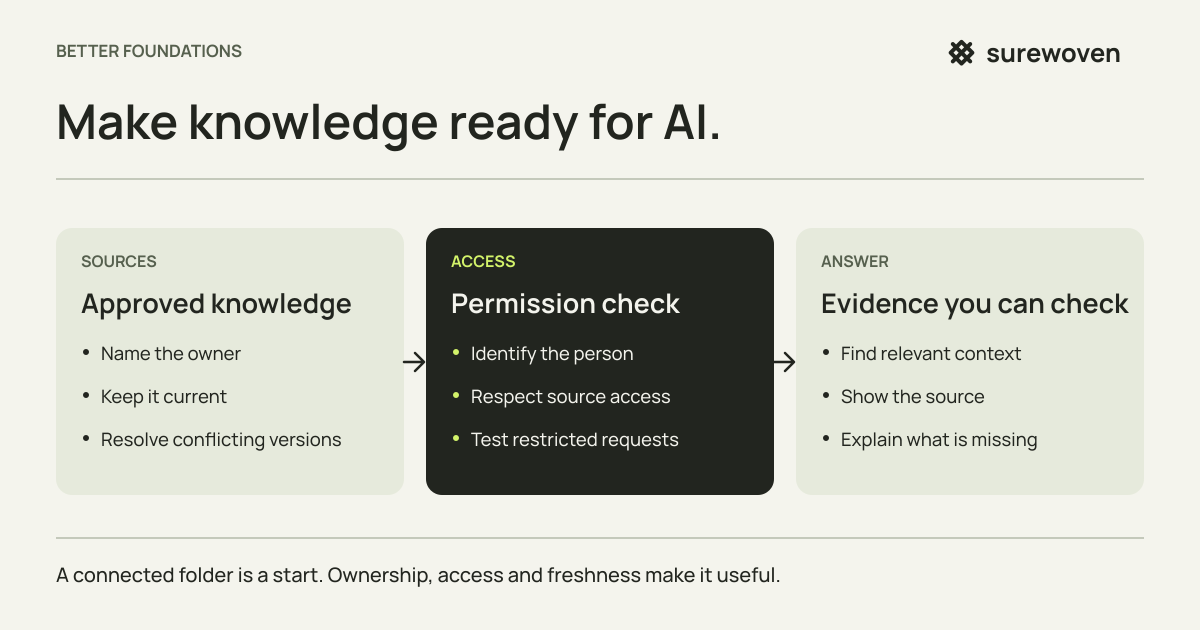
Name an owner for each source
Decide which collections are authoritative and who is responsible for them. An approved procedure, an old draft and a discussion about a possible change should not all carry the same weight.
Make freshness a deliberate choice
Record how frequently the source changes and how updates or deletions reach the search system. Test what happens when a document is replaced. Showing a source link is useful only if the underlying information is still appropriate.
Carry permissions through the whole journey
A person should only receive information they are allowed to access. This requires more than hiding a menu item. Test retrieval, generated answers and citations using identities with different access levels.
Build a test set from real questions
Collect the questions your team actually asks. Include ambiguous wording, questions with no available answer and attempts to retrieve restricted content. Review answers for relevance, evidence and completeness, not just how fluent they sound.
Make uncertainty visible
A useful answer shows the supporting source and admits when information is incomplete. Give people a way to flag an incorrect answer or contact the source owner. Keep those feedback loops in place after launch.
A source-readiness record for your team
Start with one maintained collection and complete this record with its owner. Unresolved fields are preparation tasks, not a reason to connect more documents. Revisit the record when the source or its permissions change.
| Field | What to agree |
|---|---|
| Source and owner | Which collection is authoritative and who can approve corrections. |
| Content status | How approved material is distinguished from drafts and superseded versions. |
| Access | Who may retrieve the content and open the supporting source. |
| Updates and deletion | How changes reach the search system and how removed content is withdrawn. |
| Test questions | Real questions, expected evidence, restricted requests and questions without an answer. |
| Feedback route | Where a person reports an error and who resolves it. |
This guide shares a practical approach to evaluating AI. Any examples are illustrative; the right design and results depend on your business, systems and scope.